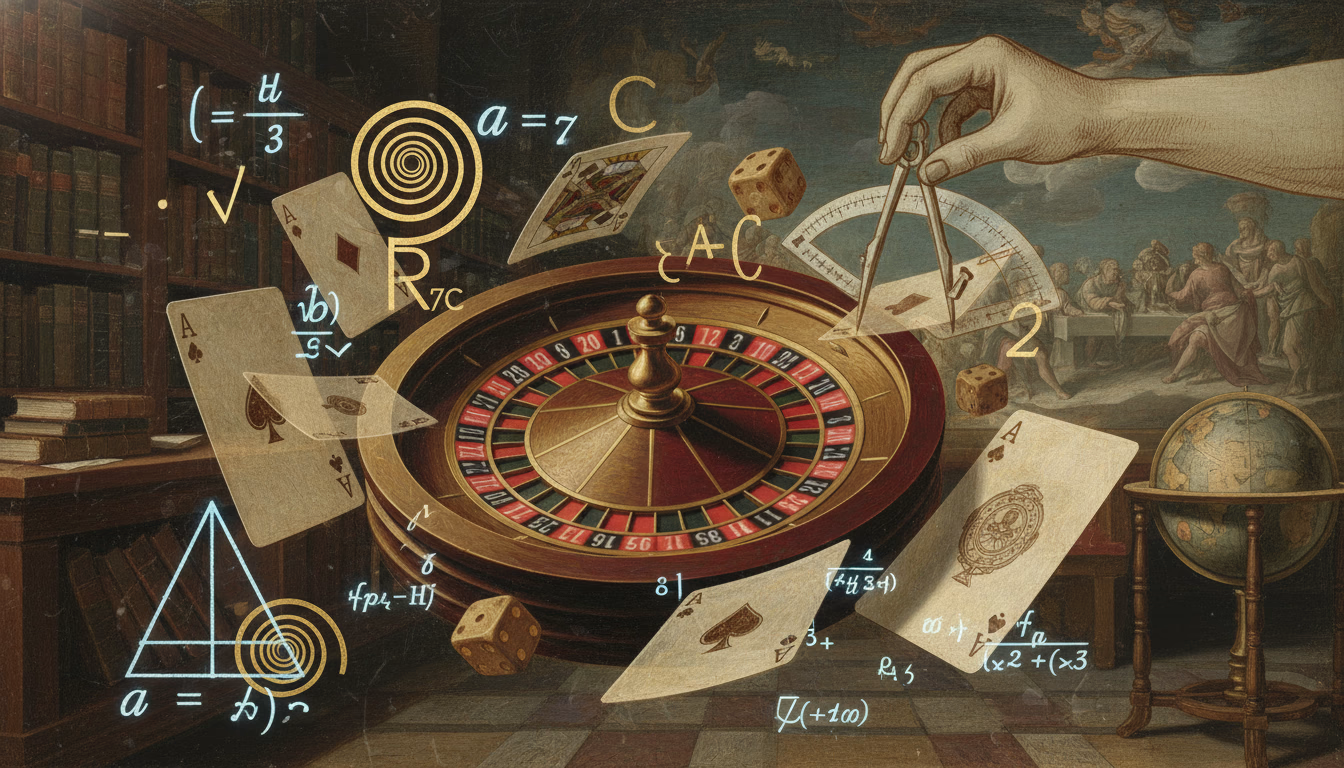
Why this page changed. It used to promise tactics “no one else dares to reveal” and betting patterns drawn from the golden ratio that would turn chance into “a mathematical ballet”. The golden ratio is real and the art history is real; the betting system is not. Here is what the mathematics actually says, which is both shorter and more useful.
The one line that settles every staking system
The expected cost of a session is the total amount you stake multiplied by the house edge. A staking system changes the order and the size of individual bets; it never changes that product except by increasing the first term. This is not an empirical claim that could turn out differently tomorrow — it follows from the fact that expectation adds up across independent bets, whatever pattern you arrange them in.
So a system can make a session feel different, and it can change how the money is distributed over the evening. It cannot make a negative expectation positive, and any page that suggests otherwise has skipped this paragraph.
The three classics, and how each one fails
Martingale doubles the stake after every loss, so one win recovers everything. It fails on two hard walls: the table maximum and your bankroll. Ten consecutive losses on an even-money bet is roughly a one-in-a-thousand event, which sounds rare until you notice it needs a stake of 1,024 units to answer.
Fibonacci climbs more gently along 1, 1, 2, 3, 5, 8. The gentleness is real and so is the consequence: it takes longer to recover and it still ends at the same wall, just later.
Golden ratio staking multiplies the stake by roughly 1.618 instead of by 2. It is Fibonacci in a dinner jacket. The proportion is beautiful in a facade by Alberti; a roulette wheel has no proportions for it to be beautiful in.
What systems really change
Variance, and nothing else. A Martingale produces many small wins and rare catastrophic losses; a flat stake produces a wider spread of ordinary results. Both have the same expected cost. Choosing between them is a choice about the shape of the evening, and it is a legitimate choice as long as you know that is what you are choosing.
The one real exception, and why it is different
Card counting in blackjack does change the edge, and it is worth understanding why, because the reason is exactly what betting systems lack. Cards are dealt without replacement, so the composition of the remaining shoe changes as play goes on; when it is rich in tens and aces the player’s expectation genuinely rises. Counting is not a staking pattern imposed on random events — it is information about a process with memory. Roulette wheels, dice and slot machines have no memory, which is why nothing analogous exists there.
Frequently asked questions
Does any betting system beat roulette?
No. Expectation adds across independent bets, so no arrangement of stakes changes the total expected loss.
Is the golden ratio useful in gambling at all?
Only as decoration. It describes proportions in art and nature; it has no relationship to the distribution of numbers on a wheel.
Why do systems seem to work at first?
Because they win often and lose rarely but heavily. A short sample mostly contains the wins, which is exactly the shape that builds false confidence.
What actually decides how much a session costs?
Three things you control: the stake, the number of bets and the stated return of the game you chose.